The Market Maker’s Guide to Decentralized Exchange - 2025 Edition

Earlier this year, I put together a roadmap for a major market maker as they prepare for their inevitable expansion into crypto.

The opportunities are broad, and evolving. This list isn't meant to be exhaustive, but rather a practical reference for trading firms seriously thinking about building or expanding a crypto business. It also serves as an update to my 2018 post, acknowledging that many of those protocols and conclusions are out of date.
Classic Strategy: Spot vs ETF and Exchange Arbitrage
The foundational crypto strategy mirrors a traditional market-making model: connecting to multiple exchanges (Coinbase, Binance, etc) and executing cross-venue arbitrage. The objective is to keep price aligned across markets by executing arbs and moving capital efficiently between venues. Prime brokerage infrastructure supports this by providing intraday loans and facilitating rapid settlement. Execution relies on existing latency-optimized infrastructure, adapted for crypto-exchange APIs and custody layers.
For spot vs ETF opportunities, MMs operates as an AP for major products such as the iShares ETFs. This role enables the create/redeem functionality which allows APs to settle with the fund in-cash or more recently in-kind. MMs hedge the ETF against the crypto exchanges and related instruments, executing across multiple venues, products, currencies, and jurisdictions where the MM already has deep operational expertise.
RFQ Integration into Web3 Products
Request for Quote (RFQ) systems are becoming a dominant model for market makers to interact directly with retail users in Web3. RFQ integrations can occur through decentralized exchanges (DEXs), Web3 product front ends, aggregators, or directly within wallet interfaces. The requirements for integration are minimal, notably Fireblocks infrastructure to facilitate asset movement to and from counterparties, and API access, which is typically permissioned.
DEXs designed around RFQ infrastructure include AirSwap and 0x Matcha, two of the early canonical examples. In these systems, counterparties interact off-chain to negotiate prices, with settlement occuring on-chain through smart contracts. This model preserves the bilateral nature of the traditional OTC workflow while eliminating counterparty risk through atomic settlement. Market makers respond to quote requests in real time, using signed messages and off-chain communication channels optimized for gas efficiency, privacy, and flexibility for institutional sized orders.
Compared to the Automated Market Maker (AMM) model, the RFQ model eliminates inherent price inefficiencies. Many AMMs have therefore incorporated RFQ quoting into their native front ends, allowing users to compare on-chain pool pricing with direct market maker quotes. Platforms such as UniswapX and Jupiter aggregate liquidity from both their internal AMM and RFQ, and when a user requests a quote they are seeing the aggregate of both options. In practice, RFQ often wins, and therefore connecting and providing pricing through these interfaces should be considered a large opportunity for MMs as well.
Aggregators such as 1inch act as meta-layers on top of existing DEX and RFQ infrastructure, and additionally connect directly to market makers. They simultaneously will query all DEXes and the Market Makers, and present the best option to the users. Often aggregators are integrated directly into wallets, which gives broader distribution directly out of the gate.
Wallets are increasingly evolving into full DeFi execution surfaces. Products like Metamask, Phantom, and Exodus now feature native swap functionality that aggregate quotes from both aggregators and direct market makers, effectively aggregating the aggregators. It all comes down to cost here. As the Wallets control the user-flow, they want to internalize as much of the spread as possible as it’s core to their business model.
Going Multi-Chain: From Wrapping to Intent Protocols to Harbor
It’s worth highlighting the evolution of multi chain infrastructure since MMs likewise can provide liquidity and/or arb against these solutions, and incorporating BTC should be considered the largest opportunity in terms of volume and pnl. Initially, “cross-chain” meant wrapping or bridging, where a smart contract custodied assets on one chain while minting representations on another. This had limited adoption since users want to hold native assets rather than wrapped tokens.
Intent-based protocols are a newer concept for Web3 execution, where users post their intents or generalized trade goals, and then market makers called “solvers” compete to execute them by finding the most efficient route and/or price. Effectively the solvers act as RFQ-responders, eventually settling the transaction on-chain and often on multiple chains. In many ways AirSwap was the original intents protocol, and the advantages and limitations we became intimately familiar with.
THORChain was a major protocol that brought native BTC into the cross chain universe, using an AMM model combined with threshold signatures and a multi-party validator set. It enabled direct swaps between BTC and EVM-based assets without relying on wrapped tokens or bridging. This design marked a scalable framework for native asset trading across heterogeneous chains. Finally, @Harbor_DEX combines and optimizes several of these ideas, ultimately providing a way for market makers to quote directly into Web3 wallets any asset on any chain, either native or wrapped. Harbor launches as a cross-chain CLOB, providing familiar APIs, deterministic price control, and native cross-chain settlement. It operates entirely as back-end infrastructure and integrates directly into wallets rather than maintaining a front end and engaging with retail users. Once scaled, Harbor could provide MMs a unified interface for quoting seamlessly across all Web3 wallets and ecosystems.
Arbing CeFi vs DeFi
Automated Market Makers (AMMs) represent a structurally inefficient pricing model compared to traditional order books. This inefficiency gives rise to MEV extraction and front-running by bots competing to capture arbitrage between pools and centralized markets, or trying to arb the AMM against itself for large enough orders.
Pricing inefficiencies can be large between AMMs and centralized exchange, which is lucrative to many of the current players. AMM pool prices often deviate and market makers bring them back in line, collecting an immediate spread.
However, executing this type of strategy requires both a different approach to price-interpretation when compared to CLOBs, and also requires node infrastructure. AMM quotes are expressed in size-dependent curves rather than discrete order book levels, so the market maker must dynamically compute executable size and effective price before analyzing the trade. Moreover, successful on-chain arbitrage demands efficient blockchain infrastructure: direct node access, optimized transaction propagation, and reliable block inclusion strategies to minimize front-running or failed transactions.
In practice, the challenge is winning the block, where multiple arbitragers have already identified the arb. Transactions must be both fast and discreet, broadcasted through private relays or specialized builders to avoid public mempool exposure and frontrunning. With the right infrastructure and blockchain systems, CeFi-DeFi arbitrages become a profitable endeavor.
Derivatives, Perpetuals and Options
Decentralized derivative markets are evolving rapidly, led by perpetual futures (perps) and option protocols that mirror traditional leverage and hedging instruments. Among these, Hyperliquid stands out for its robust perps design where longs and shorts are balanced through an interest-rate set by the market to balance supply and demand.
Hyperliquid also pioneered the HLP, which introduces pooled vaults that allow users to passively participate in the PnL of active market makers, and reduces capital requirements for market makers. In effect, the exchange’s margin system is funded by depositor vaults, enabling users to share in both funding income and trading PnL. This design aligns incentives between liquidity providers, market makers, and the exchange itself, and represents a meaningful innovation in decentralized leverage.
Another important development is Ethena, which integrates derivatives to generate synthetic dollars. Ethena’s model opens or closes hedged positions pairing long spot and short perp trades to maintain the stable asset and issue the stablecoin. Each user mint or redemption event requires a market maker to facilitate the hedge in real time, creating volume and recurring arbitrage opportunities.
Expansion into futures and options is a natural extension of MM existing expertise. The core skills of basis management, funding arbitrage, inventory hedging, and capital optimization translate directly into this new environment. With appropriate custody and execution infrastructure, MMs could operate across these venues just as it does in traditional derivatives markets, capturing both structural inefficiencies and emerging flow.
Token Market Making
When a new protocol token launches, it typically requires immediate liquidity on centralized exchanges. Market makers often enter structured agreements with the protocol’s foundation or treasury. These arrangements usually take the form of loan-and-option packages, where the MM receives an inventory loan of tokens and accompanying call options that allow purchase at a fixed strike price. For example, if a token doubles post-launch, the market maker may exercise the option to buy a portion of the loaned tokens at the predetermined strike, realizing a substantial profit.
Over time, this practice is likely to evolve or fade out as it lacks transparency and disadvantages both retail and the protocol foundation, to the benefit of market makers. Nevertheless, newly launched tokens will continue to require liquidity support, so variations of this structure are expected to persist in some form.
At Harbor we are exploring a model that improves alignment by pairing market makers directly with token teams and enabling them to distribute liquidity through Web3 wallets rather than centralized exchanges. This approach keeps settlement on-chain, increases transparency, and allows users to trade directly against professional liquidity without relying on intermediated venues.
In any case, there remains significant opportunity for institutional players to engage with token issuers and design structured liquidity solutions that bring professional market-making discipline and transparency to this evolving segment of the crypto markets.
Venture Capital and New Market Entry
New markets and structural opportunities emerge in crypto roughly every 6 to 12 months, examples include mining, exchanges, OTC, smart-contract chains, ICOs, DEXs, yield farming, stablecoins, RFQ, perps, and most recently ETFs/DATs. This cycle of invention and reinvention has been consistent since Bitcoin’s inception, and is likely to continue as the ecosystem matures. The early entrants to these new sectors tend to capture the vast majority of the gains, benefiting from low initial competition and asymmetric access to information.
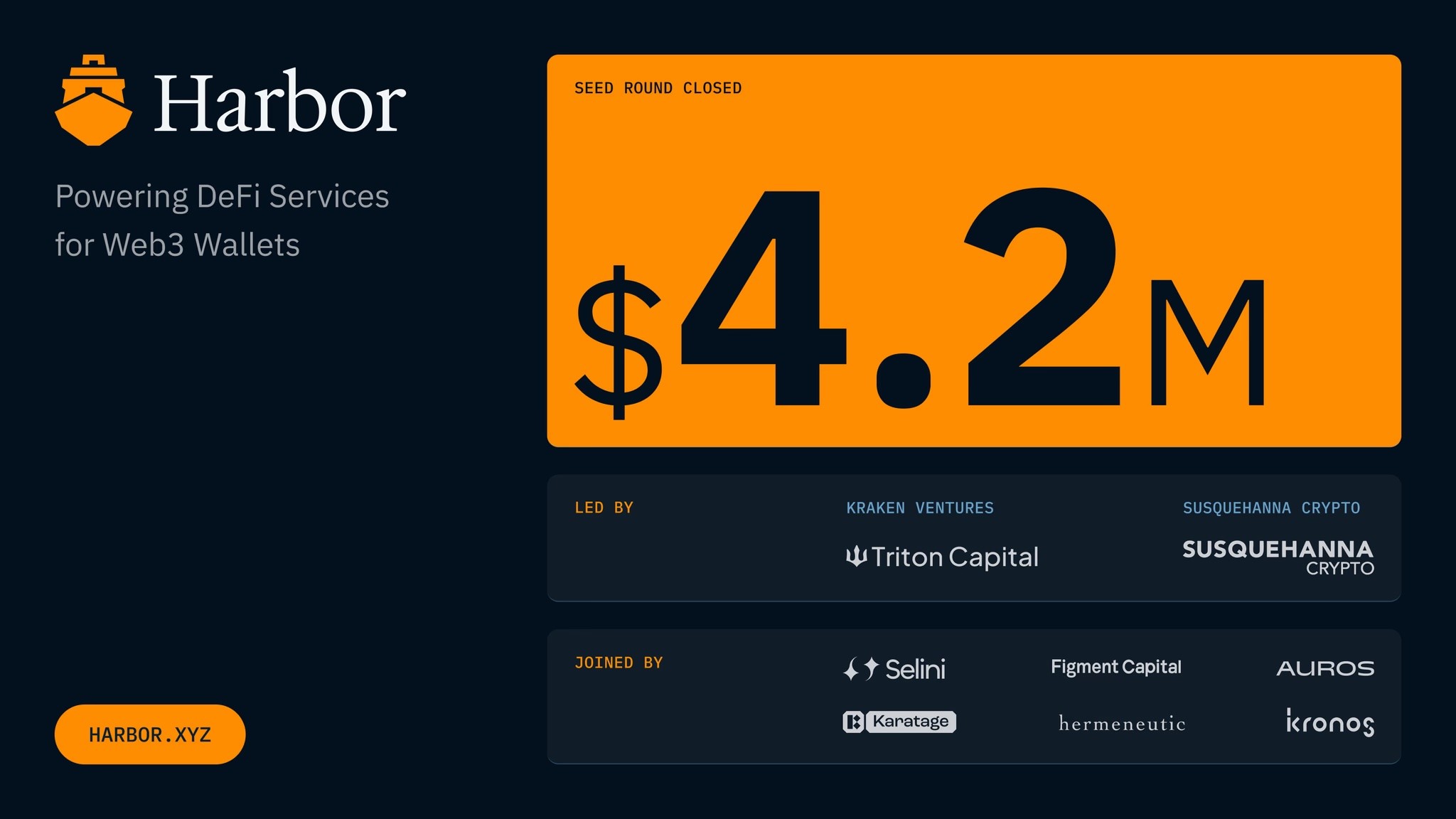
Many crypto market makers maintain dedicated Venture Capital teams, not only to invest but to gain early insight into upcoming market structures and liquidity needs. These investments create aligned exposure for equity or token upside as the firm can use its own infrastructure to bolster usage and metrics. I believe that VC investments constitute a lot of the upside for players like Jump, Flow, and Wintermute. In my view, launching a strategic pocket of VC and providing capital markets expertise including but not limited to liquidity provisioning should bolster an early team and therefore the VC investment itself. Harbor, as an example, has four market makers on the cap table; we aligned them early by getting them into the seed round and we expect they will be substantial long term partners to our protocol.
Follow us @Harbor_DEX for more interesting market insights.